Web development is one of the most in-demand skills in the digital world today. Whether you are a student exploring career options, a business owner trying to understand how websites are built, or someone who simply wants to learn coding — this guide will answer all your questions about web development in a simple, clear, and comprehensive way.
In this article, you will learn what web development is, the different types of web development, the tools and technologies used, career opportunities, and how to get started in 2026.
Table of Contents
What Is Web Development?
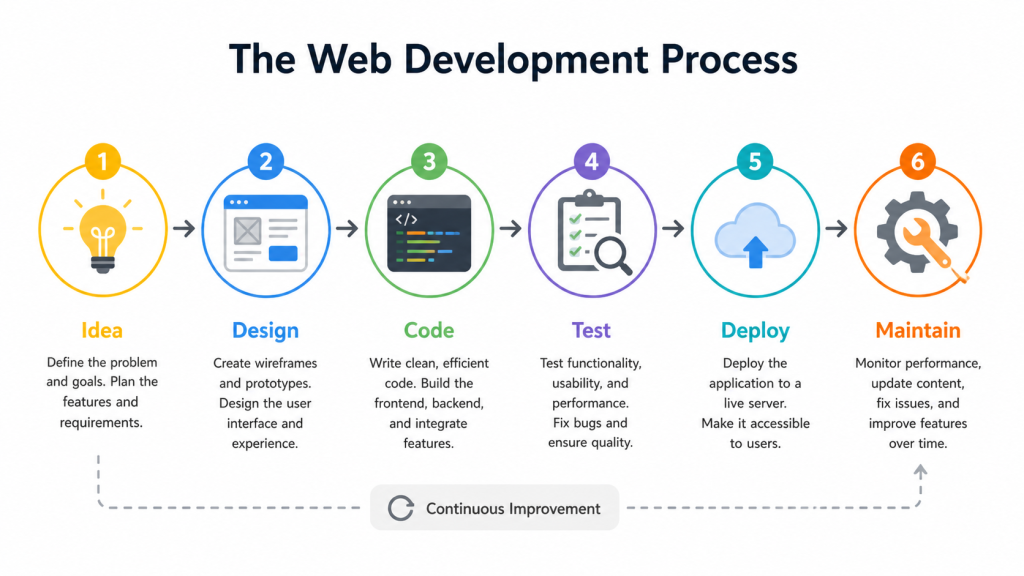
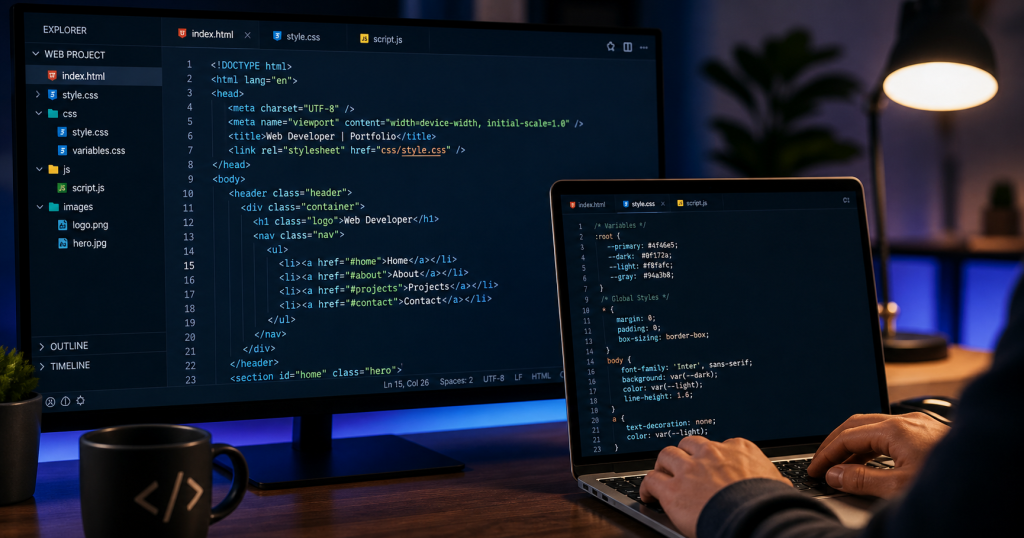
Web development is the process of creating, building, and maintaining websites and web applications that run in a web browser. It involves everything from building simple static HTML pages to complex dynamic web applications, e-commerce platforms, and social networking sites.
In simple terms, every website you visit on the internet — whether it is Google, Facebook, Amazon, or a local restaurant’s website — was built by web developers. Web development combines programming, design thinking, server management, and database handling to create functional digital products.
Definition of Web Development:
Web development refers to the work involved in developing a website for the internet (World Wide Web) or an intranet (a private network). It ranges from creating plain text pages to complex web-based internet applications, electronic businesses, and social network services.
A Brief History of Web Development
Web development has evolved dramatically since Tim Berners-Lee created the first website in 1991. The early days were about simple HTML pages with plain text. Today, modern web development includes powerful JavaScript frameworks, cloud computing, APIs, and AI-powered tools.
Types of Web Development
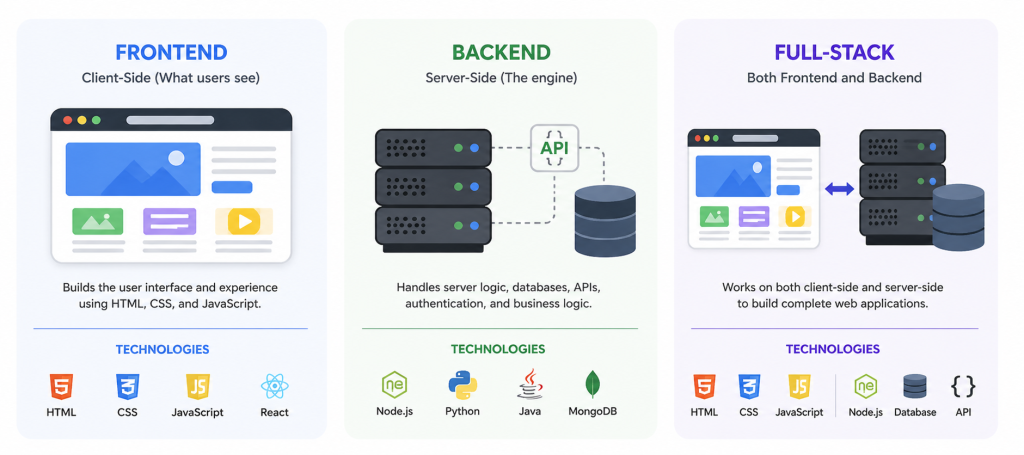
Web development is broadly divided into three types. Understanding each type is essential whether you want to build a career or hire a developer for your project.
1. Frontend Development (Client-Side)
Frontend development refers to everything the user sees and interacts with directly in their browser. It involves building the visual elements of a website — layout, colors, fonts, buttons, animations, and interactive features.
Core Frontend Technologies:
- HTML (HyperText Markup Language) — the structure/skeleton of a webpage
- CSS (Cascading Style Sheets) — the styling and visual design
- JavaScript — the interactivity and dynamic behavior
Popular Frontend Frameworks & Libraries:
- React.js (by Meta/Facebook)
- Vue.js
- Angular (by Google)
- Next.js (React framework for SSR/SSG)
2. Backend Development (Server-Side)
Backend development is what happens behind the scenes. It manages the database, server logic, authentication, APIs, and all the operations users don’t directly see. When you log in to a website, the backend checks your credentials, retrieves your data, and sends it to the frontend.
Popular Backend Technologies:
- Node.js (JavaScript on the server)
- Python (with Django or Flask)
- PHP (used in WordPress)
- Ruby on Rails
- Java / Spring Boot
Common Backend Databases:
- MySQL / PostgreSQL (relational)
- MongoDB (NoSQL)
- Firebase (real-time database by Google)
3. Full-Stack Development
A full-stack developer is someone who works on both the frontend and the backend. They have knowledge of the entire web development pipeline — from designing the UI to managing the database and deploying the application.
Full-stack development is especially popular for startups and small teams because one person can handle both sides of the application.
Popular Full-Stack Stacks:
- MERN Stack: MongoDB, Express.js, React.js, Node.js
- MEAN Stack: MongoDB, Express.js, Angular, Node.js
- LAMP Stack: Linux, Apache, MySQL, PHP
Frontend vs Backend vs Full-Stack — Key Differences
| Aspect | Frontend | Backend | Full-Stack |
| Focus | User Interface | Server & Database | Both |
| Language | HTML, CSS, JS | Python, PHP, Node | All of the above |
| Visibility | Visible to user | Hidden/server-side | Both sides |
| Tools | React, Vue, Angular | Django, Laravel | MERN, MEAN |
| Avg. Salary | $75K–$110K/yr | $85K–$120K/yr | $90K–$130K/yr |
Key Web Development Technologies & Tools
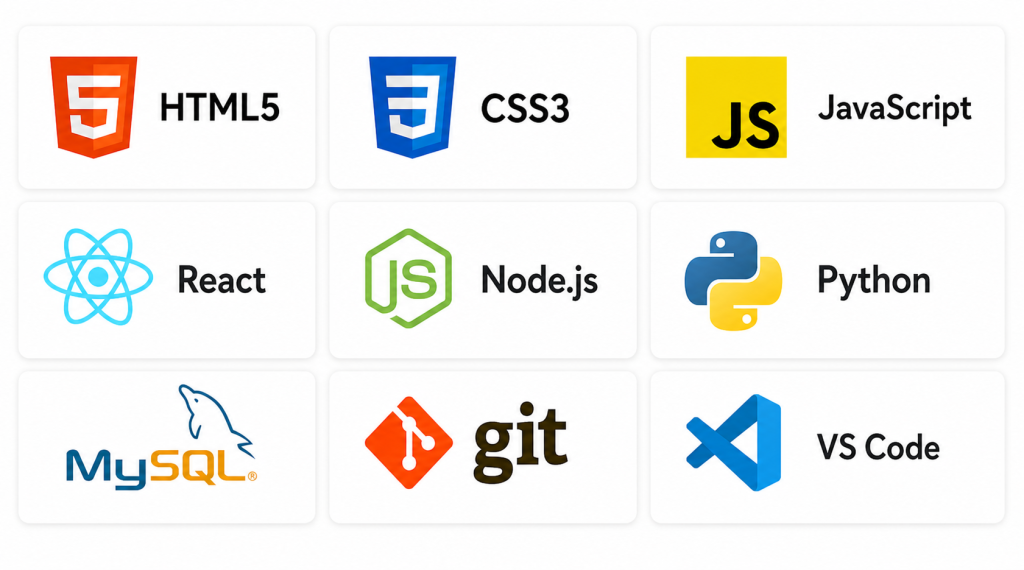
Code Editors & IDEs
- Visual Studio Code (VS Code) — most popular free editor
- Sublime Text
- WebStorm (JetBrains)
Version Control
- Git — industry-standard version control system
- GitHub — remote repository hosting and collaboration
- GitLab — open source alternative to GitHub
Web Development Frameworks (2026 Most Used)
- React.js — for dynamic, component-based UIs
- Next.js — React framework with SEO-friendly SSR
- Vue.js — lightweight, beginner-friendly
- Django (Python) — rapid, secure backend framework
- Laravel (PHP) — elegant MVC framework
Hosting & Deployment Tools
- Netlify / Vercel — for static sites and Next.js
- AWS (Amazon Web Services) — enterprise cloud hosting
- DigitalOcean — developer-friendly VPS hosting
- cPanel / WHM — traditional web hosting management
How Does a Website Work?
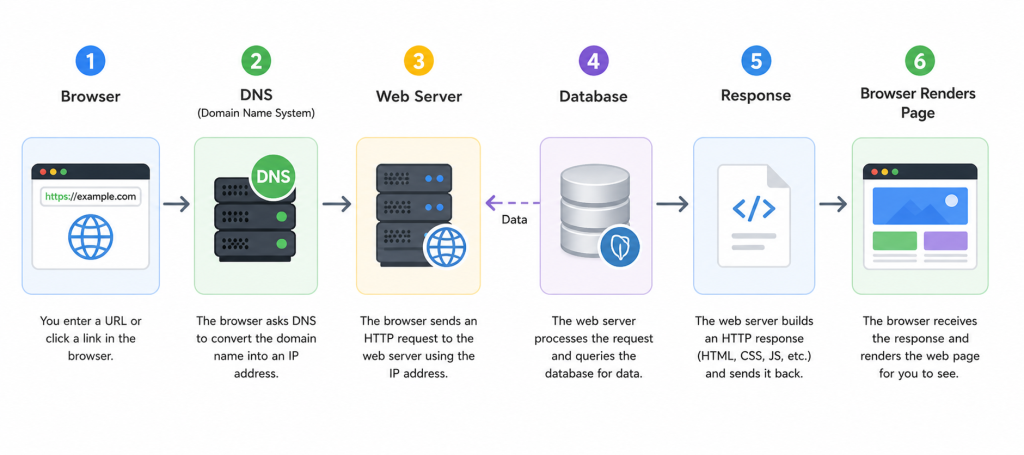
Understanding how a website works is fundamental to understanding web development. Here is a simple step-by-step breakdown:
- Step 1: You type a URL (e.g., www.expantrix.com) in your browser.
- Step 2: Your browser sends a request to a DNS (Domain Name System) server to find the IP address of the website.
- Step 3: The DNS server returns the IP address of the web server.
- Step 4: Your browser sends an HTTP/HTTPS request to the web server.
- Step 5: The web server processes the request and sends back HTML, CSS, and JavaScript files.
- Step 6: Your browser renders (displays) these files as the visual website you see.
Web Development vs Web Design — What Is the Difference?
Many people confuse web development with web design. Here is a clear distinction:
Web Design:
Web design focuses on the aesthetics and user experience (UX/UI) of a website. Designers create mockups, wireframes, and visual layouts using tools likeFigma, Adobe XD, or Canva.
Web Development:
Web development is the technical implementation of those designs. Developers write code to turn the designer’s vision into a functional, working website.
Key Difference: Designers think in visuals; developers think in code.
Career Opportunities in Web Development
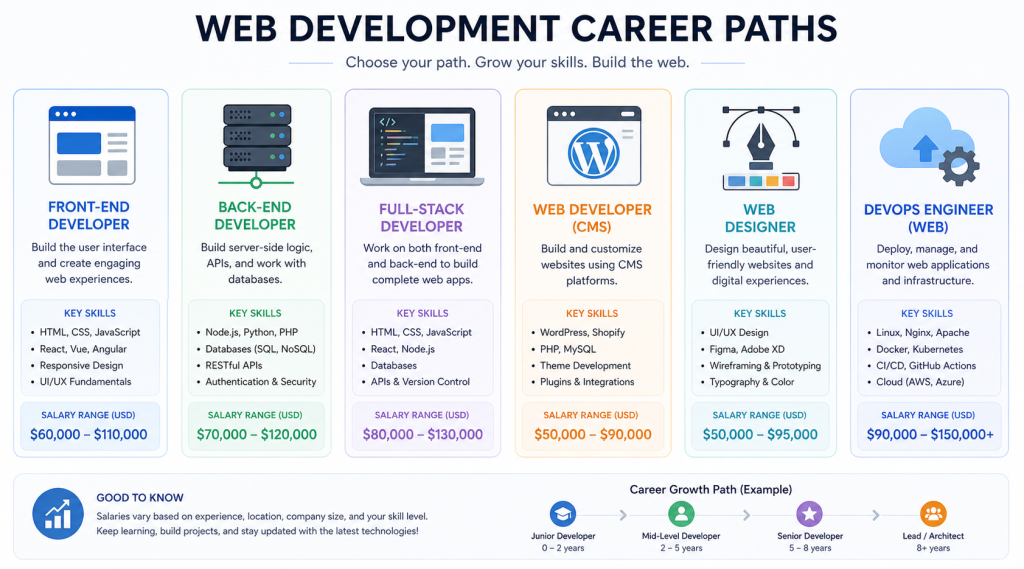
Web development offers some of the most lucrative and flexible careers in the tech industry. Here are the main career paths:
Job Roles & Average Salaries (2026)
- Frontend Developer — $75,000–$115,000/year
- Backend Developer — $85,000–$125,000/year
- Full-Stack Developer — $90,000–$135,000/year
- WordPress Developer — $55,000–$95,000/year
- DevOps Engineer — $100,000–$150,000/year
- Web Application Architect — $120,000–$160,000/year
Freelance vs Full-Time
Web development is also one of the most popular fields for freelancing. Platforms like Upwork, Fiverr, and Toptal allow web developers to work with clients from around the world, set their own hours, and earn competitive rates.
How to Learn Web Development in 2026
Learning web development has never been more accessible. Here is a step-by-step roadmap for beginners:
Step 1: Learn HTML & CSS (Weeks 1–4)
- HTML: Structure of webpages (headings, paragraphs, lists, forms, images, links)
- CSS: Styling (colors, fonts, flexbox, grid, responsive design)
Step 2: Learn JavaScript (Weeks 5–12)
- Variables, functions, arrays, objects
- DOM manipulation
- ES6+ modern JavaScript features
- Async/await and Fetch API
Step 3: Choose Frontend or Backend
- Frontend path: Learn React.js → Next.js → Tailwind CSS
- Backend path: Learn Node.js + Express → or Python + Django
- Full-Stack path: Learn both + databases (MySQL or MongoDB)
Step 4: Build Real Projects
- Personal portfolio website
- To-do list app
- Blog or e-commerce site
- REST API with database integration
Best Free Learning Resources
- freeCodeCamp.org — free full curriculum with certifications
- The Odin Project — project-based full-stack curriculum
- MDN Web Docs — best reference documentation
- YouTube channels: Traversy Media, Fireship, Kevin Powell
Web Development Best Practices in 2026
Whether you are a beginner or a professional, following best practices ensures your websites are fast, secure, and rank well on Google:
- Write clean, semantic HTML for better accessibility and SEO
- Ensure mobile-first responsive design (over 60% of traffic is mobile)
- Optimize page speed (Google’s Core Web Vitals)
- Use HTTPS (SSL certificate) for security
- Implement proper SEO: meta tags, schema markup, sitemaps
- Use version control (Git) for every project
- Write comments in your code for maintainability
- Test across multiple browsers and devices
Frequently Asked Questions (FAQ)
Q1: What is web development in simple terms?
Web development is the process of building and maintaining websites and web applications using programming languages like HTML, CSS, and JavaScript.
Q2: What skills do I need to become a web developer?
You need to learn HTML, CSS, and JavaScript as the foundation. From there, you can specialize in frontend (React, Vue), backend (Node.js, Python), or become a full-stack developer.
Q3: How long does it take to learn web development?
With dedicated daily practice (3–5 hours/day), you can learn the basics in 3–6 months and become job-ready in 6–12 months.
Q4: Is web development a good career in 2026?
Absolutely. Web development remains one of the top in-demand careers globally. With the rise of AI, cloud computing, and e-commerce, skilled developers are needed more than ever.
Q5: What is the difference between a web developer and a software engineer?
Web developers specifically focus on building websites and web applications. Software engineers have a broader scope, including desktop applications, mobile apps, operating systems, and more.
Q6: Do I need a degree to become a web developer?
No, a formal degree is not required. Many successful web developers are self-taught or have completed coding bootcamps. Building a strong portfolio is more important than a degree.
Conclusion
Web development is the backbone of the modern internet. Every website, app, and online service you use exists because of web developers who wrote the code that powers it.
Whether you want to build a career in tech, create your own website, or simply understand how the digital world works, learning web development is one of the most valuable investments you can make in 2026.
From the basics of HTML and CSS to advanced JavaScript frameworks, cloud deployment, and SEO-friendly development practices — the journey of web development is exciting, rewarding, and full of opportunities.
Ready to start your web development journey? Explore more guides on Expantrix.com!