The internet is one of the greatest inventions in human history. It has transformed the way we communicate, learn, shop, work, and entertain ourselves. Yet many people use it every single day without fully understanding what it actually is, how it works, or who controls it.
Whether you are a curious student, a business owner trying to grow online, or someone who simply wants to understand the digital world better — this complete guide will explain everything you need to know about the internet in clear, simple language.
Table of Contents
What Is the Internet? (Definition)
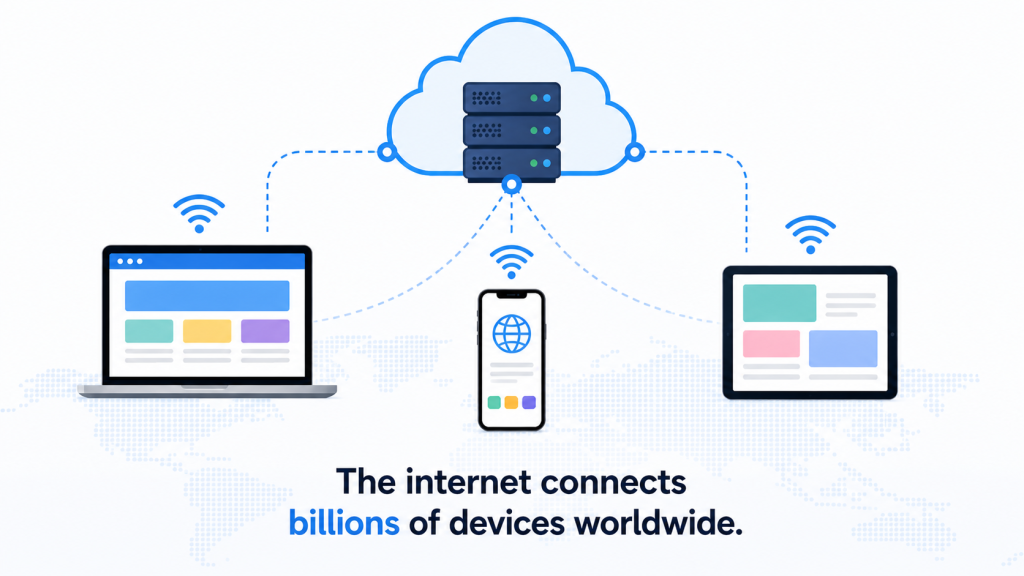
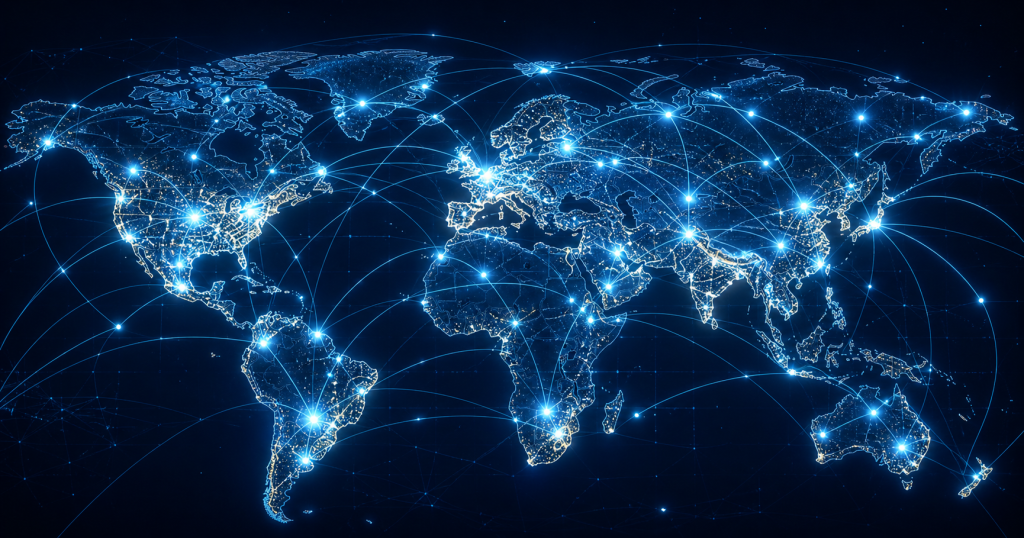
The internet is a massive global network of interconnected computers, servers, smartphones, and other devices that communicate with each other using a standardized set of rules called protocols — most importantly, TCP/IP (Transmission Control Protocol / Internet Protocol).
Think of the internet like a giant postal system. Just as letters travel through a network of roads and postal centres to reach their destination, data (text, images, videos, audio) travels through cables, satellites, and wireless signals to reach your device from a server anywhere in the world.
Simple Definition:
The internet is a global network that connects billions of devices, allowing people to share information, communicate, and access services from anywhere in the world.
Technical Definition:
The internet is a worldwide system of interconnected computer networks that use the TCP/IP protocol suite to communicate. It consists of millions of private, public, academic, business, and government networks.
A Brief History of the Internet
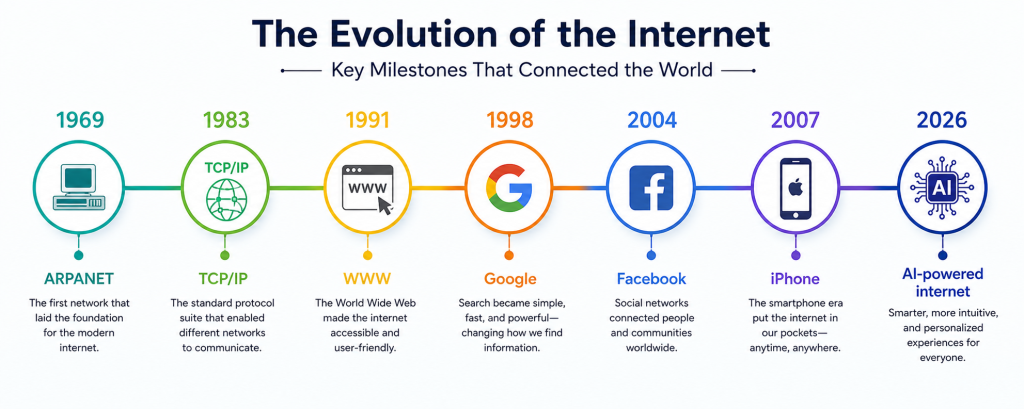
The internet did not appear overnight. Its development spans more than five decades of innovation, collaboration, and technological breakthroughs.
1969 — ARPANET: The First Network
The internet’s origins trace back to 1969, when the U.S. Department of Defense’s Advanced Research Projects Agency (ARPA) created ARPANET — a network connecting four American universities. This was the first time computers communicated with each other over a network.
1983 — TCP/IP Protocol
In 1983, ARPANET adopted TCP/IP as its standard communication protocol. This was a pivotal moment because TCP/IP became the universal language that all computers use to communicate over the internet — and it is still used today.
1991 — The World Wide Web (WWW)
In 1991, British scientist Tim Berners-Lee invented the World Wide Web — a system for creating, linking, and browsing web pages over the internet. This made the internet accessible to ordinary people, not just scientists and military personnel.
1998 — Google Changes Everything
The launch of Google in 1998 transformed how people found information online. Google’s PageRank algorithm made it possible to search billions of web pages and find the most relevant results in milliseconds.
2004–2010 — The Social Media Era
Facebook (2004), YouTube (2005), Twitter (2006), and other social platforms turned the internet into a two-way communication channel. Users were no longer just consumers of content — they became creators.
2007 — Mobile Internet Revolution
Apple’s first iPhone in 2007 triggered the mobile internet revolution. Today, more than 60% of global internet traffic comes from mobile devices.
2020s — AI-Powered Internet
The 2020s have seen artificial intelligence deeply integrated into the internet. AI-powered search, recommendation engines, chatbots, voice assistants, and content generation have fundamentally changed how we interact with the web.
How Does the Internet Work?
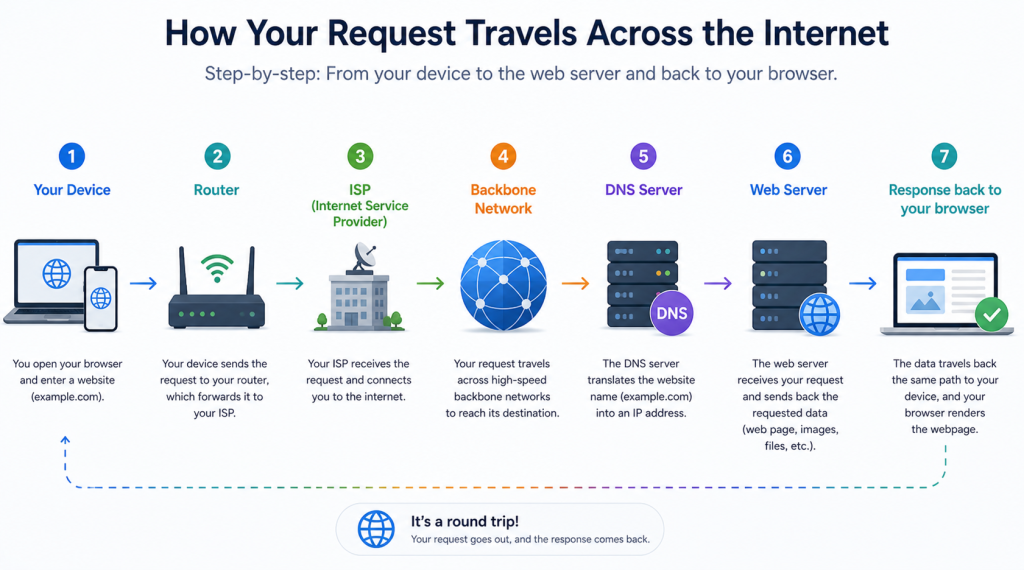
Understanding how the internet works requires knowing about a few key concepts: data packets, IP addresses, routers, and servers. Let’s break it down step by step.
Step-by-Step: How a Web Request Works
- You type a URL (e.g., www.expantrix.com) into your browser and press Enter.
- Your browser contacts a DNS (Domain Name System) server, which translates the domain name into an IP address — the numerical address of the website’s server.
- Your browser sends an HTTP or HTTPS request to the web server at that IP address.
- The request travels through your router, your ISP (Internet Service Provider), and the internet’s backbone network — a system of high-speed fibre optic cables.
- The web server receives the request, processes it, and sends back the HTML, CSS, JavaScript, and image files that make up the webpage.
- Your browser receives these files and renders (displays) the webpage on your screen.
This entire process — from you pressing Enter to the webpage appearing on screen — typically takes less than one second.
What Are Data Packets?
When you send or receive data over the internet, it is not sent as one large chunk. Instead, it is broken into small pieces called data packets. Each packet travels independently through the network and may take a different route, then they are reassembled in the correct order at the destination.
This packet-switching technology is what makes the internet so fast and resilient — if one route is congested or broken, packets simply take a different path.
Key Components of the Internet
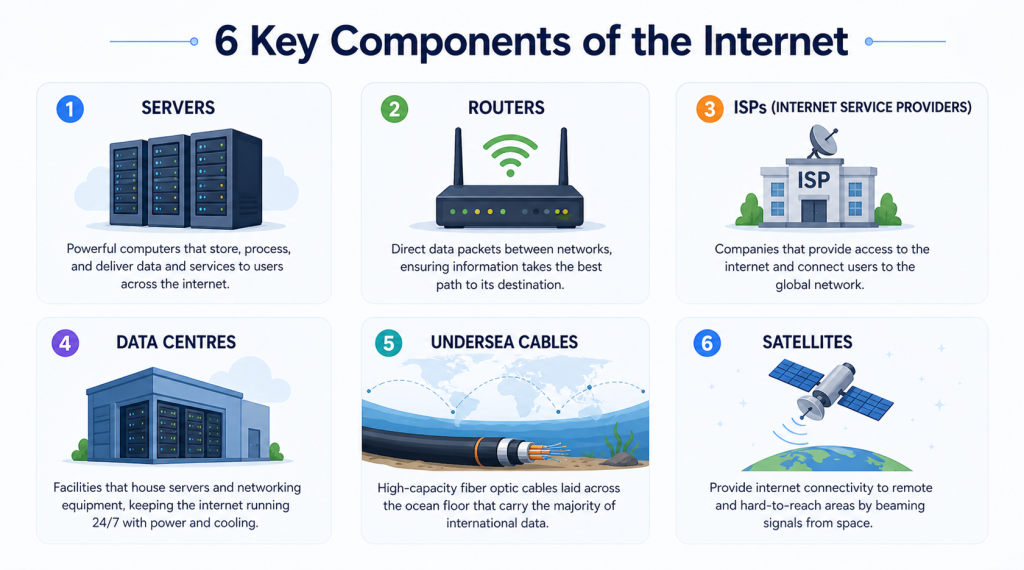
1. Servers
Servers are powerful computers that store websites, applications, videos, emails, and other data. When you visit a website, you are actually requesting files from a server. Large companies like Google and Amazon use millions of servers housed in data centres.
2. Routers
Routers are devices that direct data packets to their correct destinations. Your home Wi-Fi router connects your devices to your ISP’s network. Large industrial routers form the backbone of the internet, directing traffic between continents.
3. ISPs (Internet Service Providers)
ISPs are companies that provide you with access to the internet. Examples include Comcast, AT&T, BT, Airtel, Grameenphone, and Teletalk. ISPs connect homes and businesses to the internet’s backbone network.
4. Data Centres
Data centres are large facilities housing thousands of servers. Companies like Google, Microsoft, Amazon, and Meta operate data centres around the world to ensure their services are fast and available 24/7. Data centres require enormous amounts of electricity and cooling systems.
5. Undersea Cables
Most international internet traffic travels through undersea fibre optic cables. There are over 400 active submarine cable systems crisscrossing the ocean floor, carrying nearly 98% of all international internet data. These cables can span thousands of kilometres.
6. Satellites
Satellite internet provides connectivity to remote areas where physical cables cannot reach. Companies like SpaceX (Starlink), Amazon (Kuiper), and OneWeb are deploying thousands of low-Earth orbit satellites to provide global high-speed internet access.
Types of Internet Connections
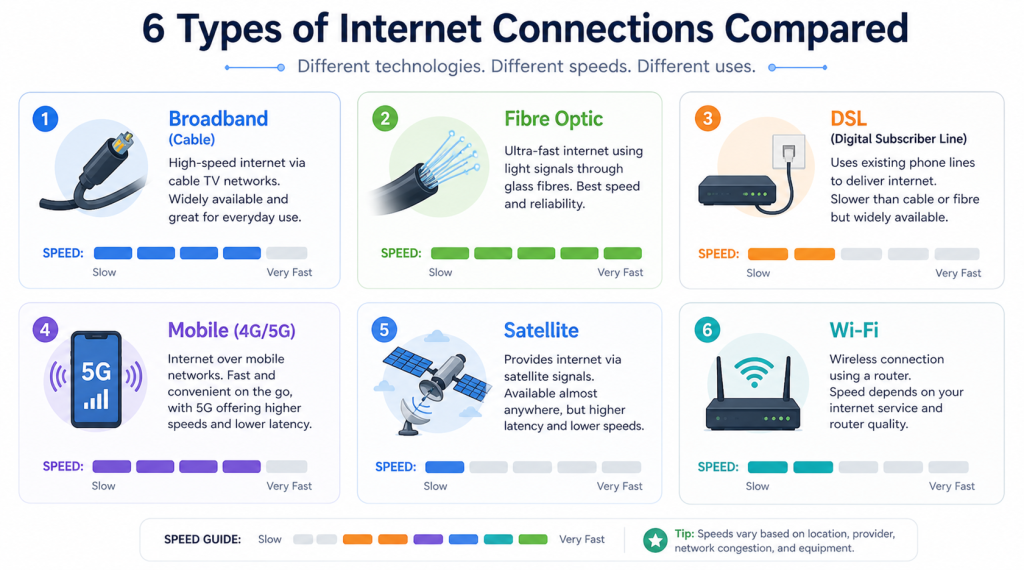
Not all internet connections are the same. Speed, reliability, and availability vary greatly depending on the type of connection you use.
| Connection Type | Typical Speed | How It Works | Pros | Cons |
|---|---|---|---|---|
| Fibre Optic | 100 Mbps–10 Gbps | Light through glass cables | Fastest & most reliable | Not everywhere |
| Broadband Cable | 25–300 Mbps | Coaxial cable (TV lines) | Widely available | Shared bandwidth |
| DSL | 1–100 Mbps | Phone lines | Affordable | Slower than fibre |
| 5G Mobile | 100 Mbps–1 Gbps | 5th-gen wireless | Very fast & mobile | Coverage gaps |
| 4G/LTE | 10–100 Mbps | 4th-gen wireless | Wide coverage | Slower than 5G |
| Satellite | 25–220 Mbps | LEO/GEO satellites | Works anywhere | Higher latency |
| Wi-Fi | Varies | Wireless radio signals | Convenient & shared | Limited range |
The World Wide Web vs. the Internet — What’s the Difference?
These two terms are often used interchangeably, but they are not the same thing. This is one of the most common misconceptions about the internet.
The Internet:
The internet is the physical infrastructure — the global network of cables, routers, servers, and satellites that connect devices worldwide. It is the ‘highway’ of global communication.
The World Wide Web (WWW):
The World Wide Web is a service that runs on top of the internet. It is a collection of billions of web pages and websites that you access through a browser. The Web uses HTTP/HTTPS protocols to transmit data.
Analogy: The internet is the road. The Web is the cars (websites) that travel on that road. Email, video calls, and online gaming are also ‘cars’ — services that use the internet but are not part of the Web.
| Internet | World Wide Web (WWW) |
|---|---|
| Global physical network | A service that runs on the internet |
| Cables, routers, servers | Web pages, websites, browsers |
| Invented ~1969 (ARPANET) | Invented 1991 by Tim Berners-Lee |
| Carries all internet traffic | Carries only web (HTTP) traffic |
| Examples: email, FTP, VoIP | Examples: Google, YouTube, blogs |
What Can You Do on the Internet?
The internet has become so central to modern life that it is easier to list what you cannot do on it. Here are the major categories of activities people use the internet for:
Communication
- Email (Gmail, Outlook, Yahoo Mail)
- Instant messaging (WhatsApp, Telegram, Signal)
- Video calls (Zoom, Google Meet, FaceTime)
- Social media (Facebook, Instagram, LinkedIn, X/Twitter)
Information & Education
- Search engines (Google, Bing, DuckDuckGo)
- Online encyclopaedias (Wikipedia)
- E-learning platforms (Coursera, Udemy, Khan Academy)
- News websites and digital newspapers
Commerce & Finance
- Online shopping (Amazon, eBay, local e-commerce)
- Online banking and payments (PayPal, Stripe, bKash)
- Freelancing platforms (Upwork, Fiverr)
- Cryptocurrency and digital investments
Entertainment
- Streaming video (YouTube, Netflix, Disney+)
- Music streaming (Spotify, Apple Music)
- Online gaming
- Podcasts and audiobooks
Work & Business
- Remote work tools (Slack, Teams, Notion)
- Cloud computing (Google Drive, Dropbox, AWS)
- Digital marketing and SEO
- Web development and software deployment
How the Internet Has Changed the World
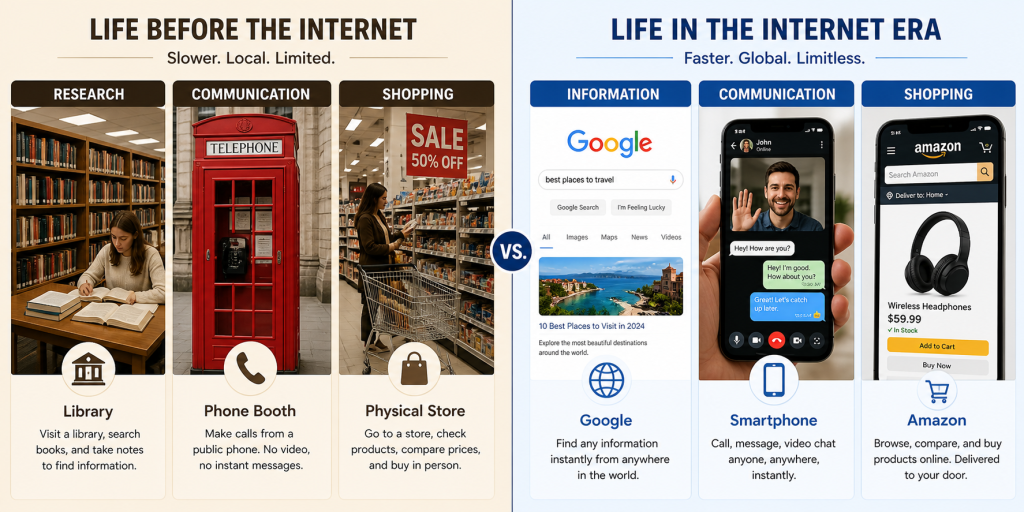
1. Communication: From Days to Seconds
Before the internet, a letter took days or weeks to arrive. An international phone call was expensive. Today, you can send a message, video, or document to anyone on the planet instantly and for free.
2. Access to Knowledge
For most of human history, knowledge was limited to those who could afford books or access libraries. The internet has democratised information — anyone with a device and a connection can access virtually the sum of human knowledge.
3. The Global Economy
The internet created a global digital economy worth trillions of dollars. E-commerce, digital services, remote work, and the gig economy have reshaped how businesses operate and how people earn a living.
4. Healthcare
Telemedicine, online medical databases, health monitoring apps, and AI-powered diagnostics have transformed healthcare delivery. In remote areas, the internet can be the difference between life and death.
5. Education
Online learning has made quality education accessible to millions who previously had no access. During the COVID-19 pandemic, the internet was the backbone of continued education for billions of students worldwide.
Internet Safety & Security
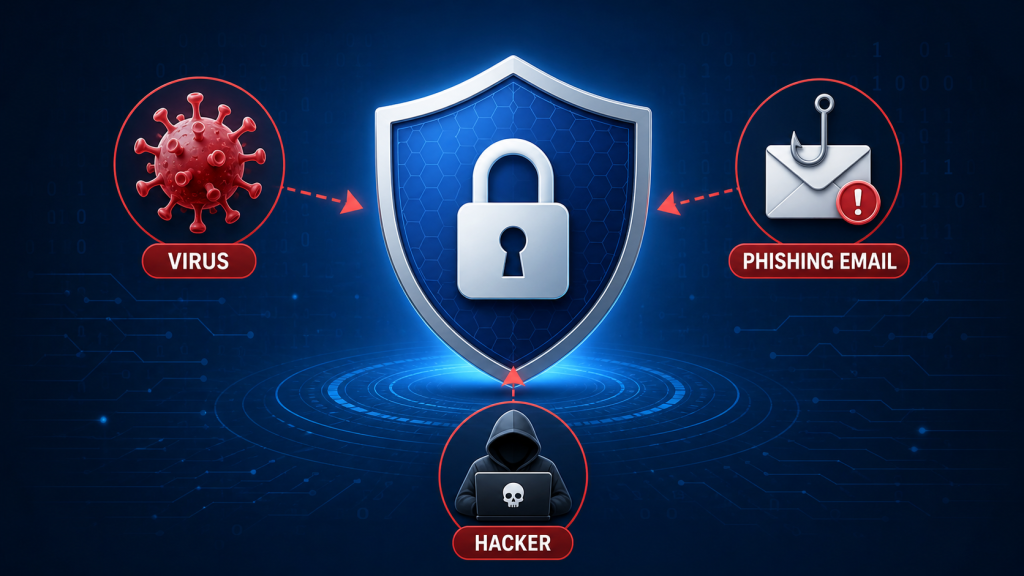
With all the benefits of the internet come serious risks. Understanding how to stay safe online is essential for everyone.
Common Internet Threats
- Phishing — Fake emails or websites that trick you into revealing passwords or financial information
- Malware & Viruses — Malicious software that can damage your device or steal data
- Ransomware — Software that locks your files until you pay a ransom
- Identity Theft — Criminals stealing your personal information to commit fraud
- Cyberbullying — Online harassment, especially on social media
- Data Breaches — When hackers steal large amounts of user data from companies
Internet Safety Tips
- Use strong, unique passwords for every account (use a password manager)
- Enable two-factor authentication (2FA) wherever possible
- Only visit HTTPS websites (look for the padlock icon in your browser)
- Keep your operating system, browser, and apps updated
- Never click on suspicious links or download unexpected attachments
- Use a reputable antivirus programme
- Be careful what personal information you share online
- Use a VPN on public Wi-Fi networks
Internet Statistics 2026
Here are some key statistics that show just how central the internet has become to global life:
- 5.4 billion people — the approximate number of internet users worldwide in 2026 (approximately 67% of the global population)
- 60%+ — the share of internet traffic coming from mobile devices
- 5 billion+ — number of active social media users globally
- 400+ — active submarine cable systems carrying international internet data
- $6.3 trillion+ — estimated value of global e-commerce in 2026
- 4.6 billion — number of emails sent every single day
- 500 hours — the amount of video uploaded to YouTube every minute
Frequently Asked Questions (FAQ)
Q1: What is the internet in simple words?
The internet is a global network that connects billions of computers, phones, and other devices, allowing them to share information and communicate with each other from anywhere in the world.
Q2: Who invented the internet?
The internet evolved from ARPANET, a network created by the U.S. Department of Defense in 1969. Tim Berners-Lee invented the World Wide Web in 1991, which made the internet accessible to the general public. Many scientists and engineers contributed to the internet’s development over several decades.
Q3: What is the difference between the internet and Wi-Fi?
The internet is the global network itself. Wi-Fi is a wireless technology that allows your devices to connect to the internet through a local router without using physical cables. Wi-Fi is just one method of accessing the internet — you can also connect via mobile data (4G/5G), fibre optic cables, or satellite.
Q4: What is the difference between the internet and the intranet?
The internet is a public global network accessible to everyone. An intranet is a private network used within an organisation (like a company or school) that uses the same technology as the internet but is not accessible to the general public.
Q5: Is the World Wide Web the same as the internet?
No. The internet is the physical global network (cables, servers, routers). The World Wide Web is one service that runs on top of the internet — it is the system of web pages you access through a browser. Email, video calls, and online games also use the internet but are not part of the Web.
Q6: How much of the internet is the Dark Web?
The surface web (websites indexed by search engines) represents only about 4–5% of the internet. The deep web (databases, private intranets, email servers) makes up around 90–95%. The dark web — an encrypted, intentionally hidden part of the internet — is estimated to be a very small fraction of the deep web.
Q7: Who owns or controls the internet?
No single person, company, or government owns the internet. It is a decentralised, cooperative system managed by various organisations: ICANN manages domain names, the IETF develops internet standards, and ISPs own the physical infrastructure in their regions.
Conclusion
The internet is arguably the most transformative technology in human history. In just a few decades, it has reshaped every aspect of human life — communication, education, commerce, healthcare, entertainment, and governance.
Understanding what the internet is, how it works, and how to use it safely is a fundamental digital literacy skill in 2026. Whether you are a student, professional, entrepreneur, or simply a curious person, a deeper understanding of the internet empowers you to use it more effectively and responsibly.
On Expantrix.com, we break down complex technology topics into simple, easy-to-understand guides. Stay tuned for more articles on web development, digital marketing, internet security, and the future of technology.
Explore more guides on Expantrix.com and level up your digital knowledge!