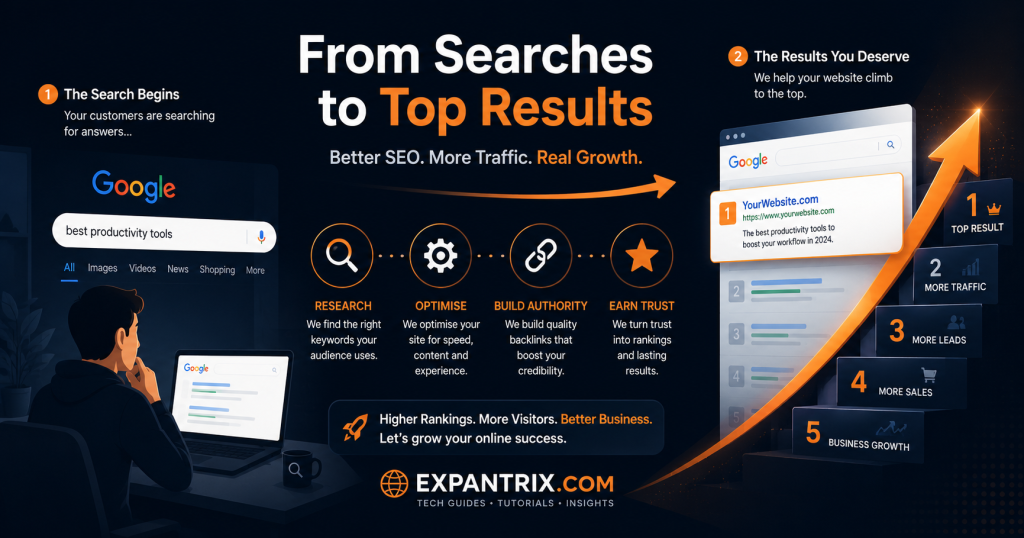
Every day, people perform over 8.5 billion searches on Google alone. Behind every search result — every website that appears on page one — is a strategy called SEO.
If you have a website or are thinking about building one, understanding SEO is not optional — it is the single most important factor in whether your website gets found by the right people or disappears into the digital void.
In this complete, beginner-friendly guide, you will learn exactly what SEO is, how it works, the different types of SEO, key ranking factors, essential tools, and a clear step-by-step strategy to start ranking on Google in 2026.
Table of Contents
What Is SEO? (Definition)
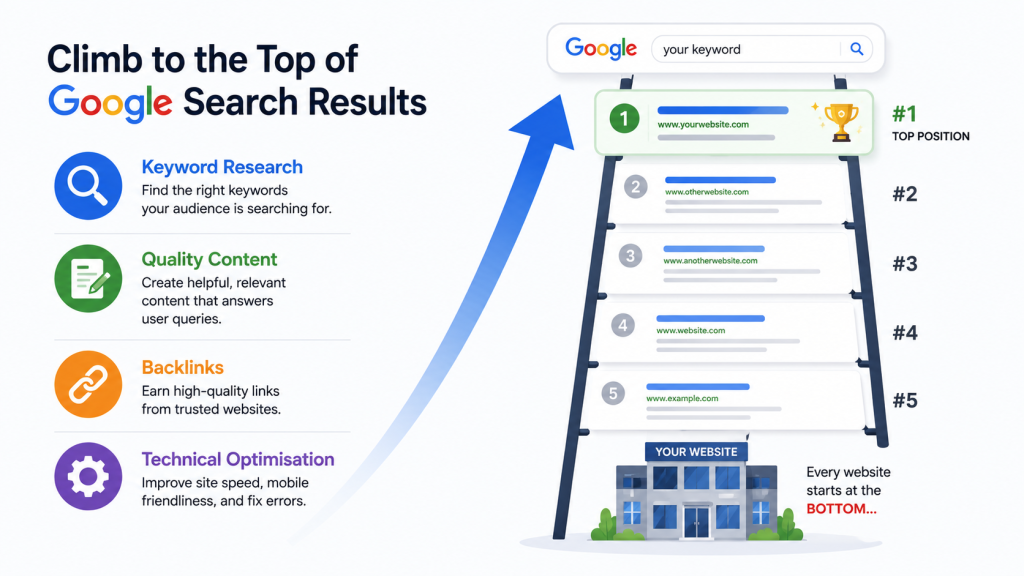
SEO stands for Search Engine Optimisation. It is the practice of improving your website so that it appears higher in search engine results pages (SERPs) — like Google, Bing, or Yahoo — when people search for topics, products, or services related to your content.
In simple terms: when someone types a question or keyword into Google, SEO determines which websites appear at the top of the results — and which ones are buried on page 5 where almost no one looks.
Simple Definition:
SEO is the process of making your website more visible, relevant, and trustworthy so that search engines rank it higher — bringing more organic (free) traffic to your site.
Technical Definition:
SEO is a set of strategies, techniques, and best practices used to increase the quantity and quality of organic traffic to a website by improving its visibility in search engine result pages (SERPs) through non-paid methods.
Organic vs. Paid Results — What’s the Difference?
| Organic Results (SEO) | Paid Results (Google Ads / PPC) |
|---|---|
| Free traffic — no cost per click | You pay for every click |
| Takes time to build (weeks to months) | Instant visibility — runs immediately |
| Long-term sustainable traffic | Traffic stops when budget runs out |
| Higher user trust (~70% of clicks) | Lower trust — users know it’s an ad |
| Earned through SEO optimisation | Purchased through Google Ads platform |
| Requires ongoing content + link work | Requires ongoing budget investment |
💡 PRO TIP: Studies consistently show that organic search results receive approximately 70–80% of all clicks, while paid ads receive 20–30%. This is why SEO is one of the highest ROI digital marketing strategies.
How Do Search Engines Work?
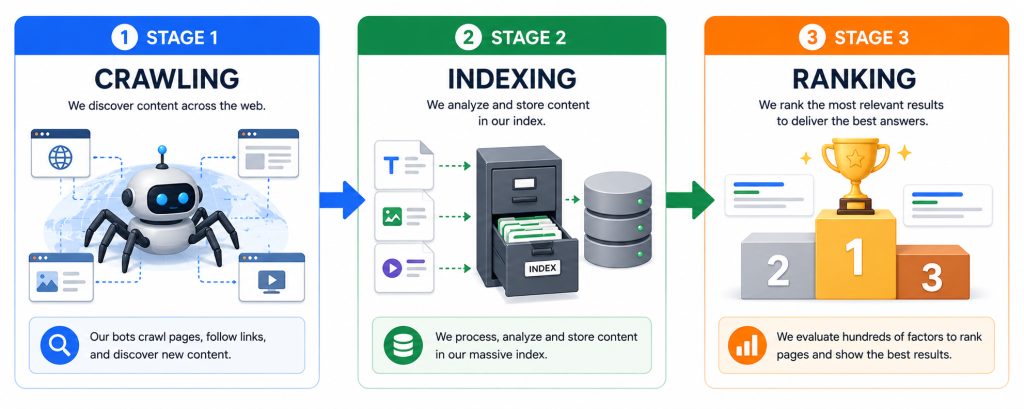
Before you can optimise for search engines, you need to understand how they work. Search engines like Google use automated programmes called crawlers (or spiders) to discover and process web pages across the internet. This happens in three stages:
Stage 1 — Crawling
Search engine crawlers (like Googlebot) constantly browse the internet, following links from page to page. They discover new pages, updated content, and removed pages. Crawlers visit billions of pages every day.
For your website to be found, it must be crawlable — not blocked by robots.txt, not hidden behind login walls, and linked to from other pages that crawlers can reach.
Stage 2 — Indexing
After crawling a page, Google processes and stores it in its index — a massive database of web pages. When a page is indexed, it becomes eligible to appear in search results. Google’s index contains hundreds of billions of web pages.
If your page is not indexed, it will never appear in search results. You can check if your pages are indexed using Google Search Console.
Stage 3 — Ranking
When someone performs a search, Google’s algorithm evaluates all indexed pages and ranks them in order of relevance and quality for that specific query. Google uses over 200 ranking factors — including content quality, backlinks, page speed, mobile-friendliness, and user experience signals.
The goal of SEO is to signal to Google that your page deserves to rank higher for relevant searches.
Why Is SEO Important?
Understanding why SEO matters is crucial before investing time and resources into it. Here are the most compelling reasons:
1. Organic Search Is the #1 Traffic Source
Organic search drives over 53% of all website traffic globally. For most websites, Google is the single largest source of visitors. Ranking on page one of Google for the right keywords can transform a website from invisible to a major business asset.
2. SEO Traffic Is Free
Unlike paid ads (Google Ads, Facebook Ads), organic SEO traffic costs nothing per click. While SEO requires an investment of time and sometimes money for tools or content creation, the traffic itself is free — and it compounds over time.
3. SEO Builds Long-Term Authority
A well-ranked page can bring consistent traffic for months or years. Unlike a paid ad campaign that stops the moment your budget runs out, a well-optimised page continues to attract visitors indefinitely.
4. Users Trust Organic Results
Research consistently shows that users trust organic search results more than paid advertisements. Appearing at the top of organic results signals credibility and authority in your field.
5. SEO Levels the Playing Field
A small business with excellent content and good SEO can outrank a large corporation with a massive advertising budget. SEO rewards quality and relevance — not just spending power.
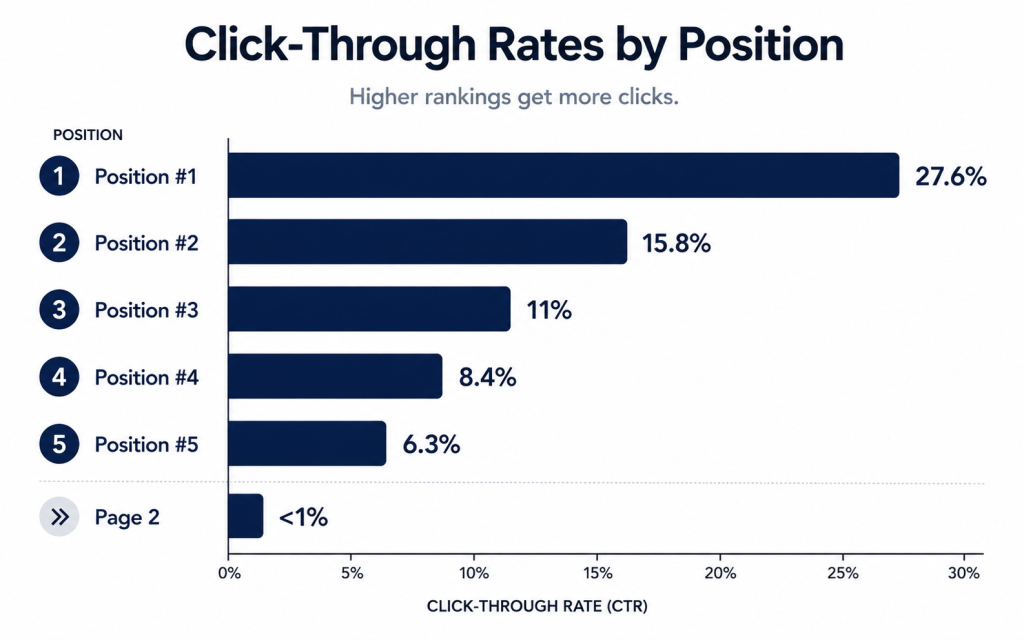
✅ SEO TIP: The difference between Position #1 and Position #10 on Google is enormous. Position #1 gets ~27.6% of all clicks; Position #10 gets only ~2.4%. Moving from page 2 to page 1 can multiply your traffic by 10–100x.
The 3 Core Types of SEO
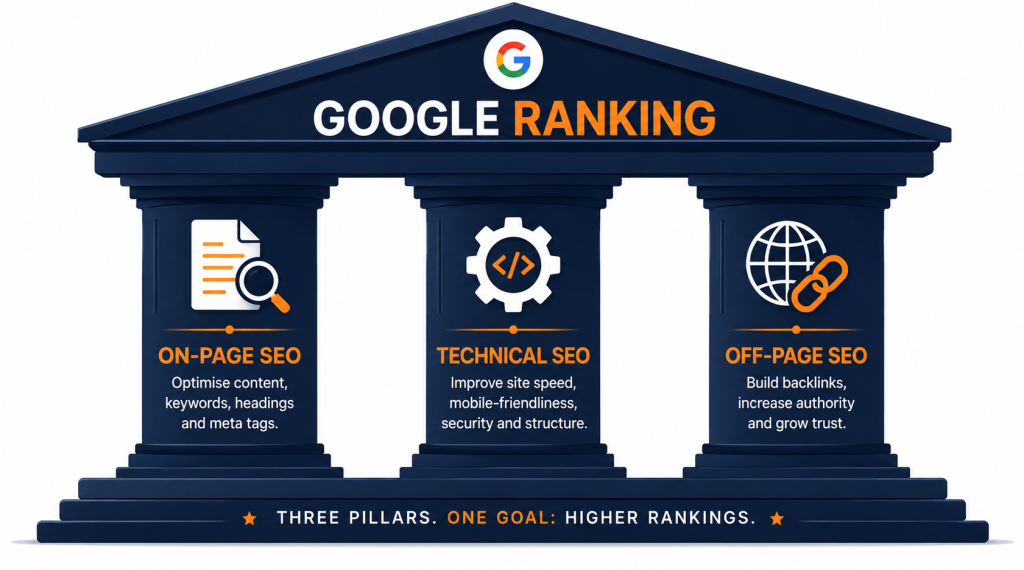
SEO is not a single strategy — it is a combination of three interconnected disciplines, each addressing a different aspect of how search engines evaluate your website:
| Type of SEO | What It Covers | Example Tasks |
|---|---|---|
| On-Page SEO | Optimising individual web pages | Keyword placement, title tags, meta descriptions, headings, content quality, internal links |
| Off-Page SEO | Building authority outside your website | Link building, guest posts, social signals, brand mentions, PR |
| Technical SEO | Technical infrastructure of the website | Page speed, mobile-friendliness, SSL, XML sitemap, robots.txt, Core Web Vitals, schema markup |
All three types must work together. The best content in the world will not rank if your site has serious technical issues. And a perfectly technical site will not rank without quality content and authoritative backlinks.
On-Page SEO — Complete Guide
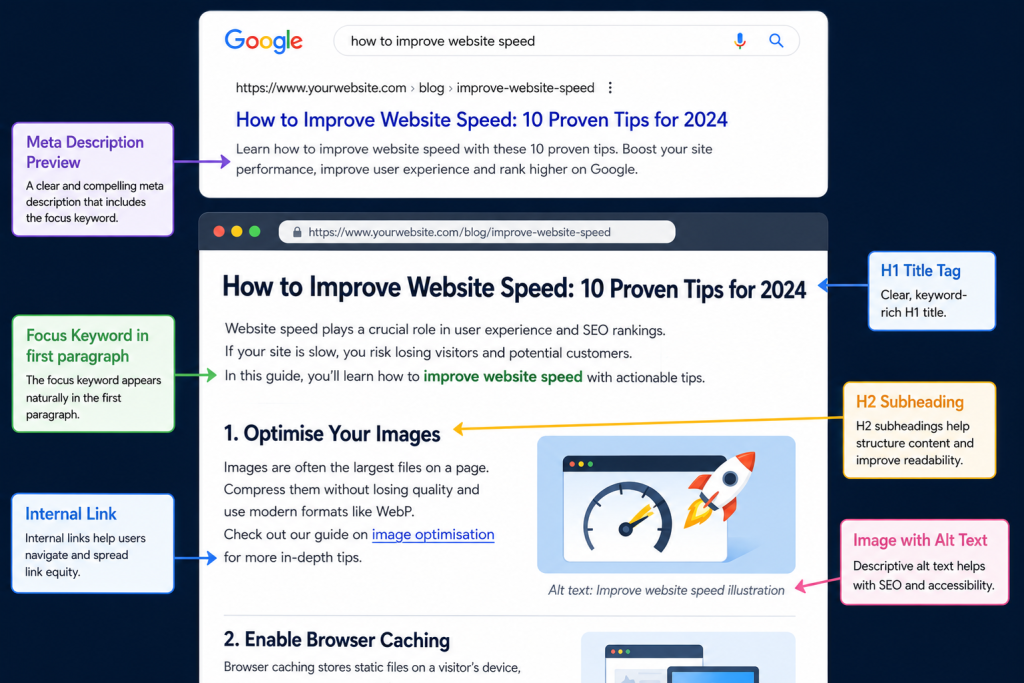
On-page SEO refers to all the optimisations you make directly within your web pages to help search engines understand your content and rank it for relevant queries.
1. Title Tag (SEO Title)
The title tag is the clickable blue headline that appears in search results. It is one of the most important on-page SEO elements. Best practices:
- Include your focus keyword near the beginning of the title
- Keep it under 60 characters to avoid truncation in search results
- Make it compelling to maximise click-through rate (CTR)
- Each page must have a unique title tag
Example: ✅ ‘What Is SEO? The Complete Beginner’s Guide (2026)’
2. Meta Description
The meta description is the short summary text that appears below the title in search results. While it does not directly affect rankings, it significantly influences click-through rate:
- Keep it between 150–160 characters
- Include the focus keyword naturally
- Write a compelling description that makes users want to click
- Include a call-to-action where appropriate
3. URL / Slug
The URL structure of a page affects both user experience and SEO:
- Use short, descriptive URLs (e.g., /what-is-seo/ not /p=1234)
- Include the focus keyword in the URL
- Use hyphens to separate words (not underscores)
- Avoid numbers, dates, or special characters where possible
4. Heading Tags (H1, H2, H3)
Headings help both users and search engines understand the structure of your content:
- H1: The main title of the page — use only ONE H1 per page
- H2: Major sections of the article — include secondary keywords
- H3: Subsections within H2 sections
- Include your focus keyword naturally in at least one H2
5. Keyword Placement
Strategic keyword placement helps search engines understand what your page is about:
- Focus keyword in the first 100 words of the article
- Focus keyword in at least one H2 heading
- Focus keyword in the title tag and meta description
- Naturally distribute the keyword throughout the content (avoid stuffing)
- Use LSI keywords (related terms) throughout the article
6. Image Optimisation
Images are important for user experience but must be optimised for SEO:
- File names should be descriptive: what-is-seo.jpg (not IMG1234.jpg)
- Alt text: a written description of the image for screen readers and search engines
- Compress images to reduce file size (use Web Page format in 2026)
- Use relevant images that support your content
7. Internal Linking
Internal links (links between pages on your own website) are crucial for SEO:
- They help search engines discover and understand the relationship between your pages
- They distribute ‘link equity’ (ranking power) across your site
- They improve user experience by guiding readers to related content
- Use descriptive anchor text (the clickable text of the link)
8. Content Length & Quality
Google rewards comprehensive, in-depth content that fully answers the user’s search intent:
- Pillar/cornerstone articles: 2,500–5,000+ words
- Blog posts: 1,500–2,500 words minimum for competitive topics
- Short-form: 800–1,200 words for simple queries
- Cover the topic more comprehensively than competing articles
Off-Page SEO — Complete Guide
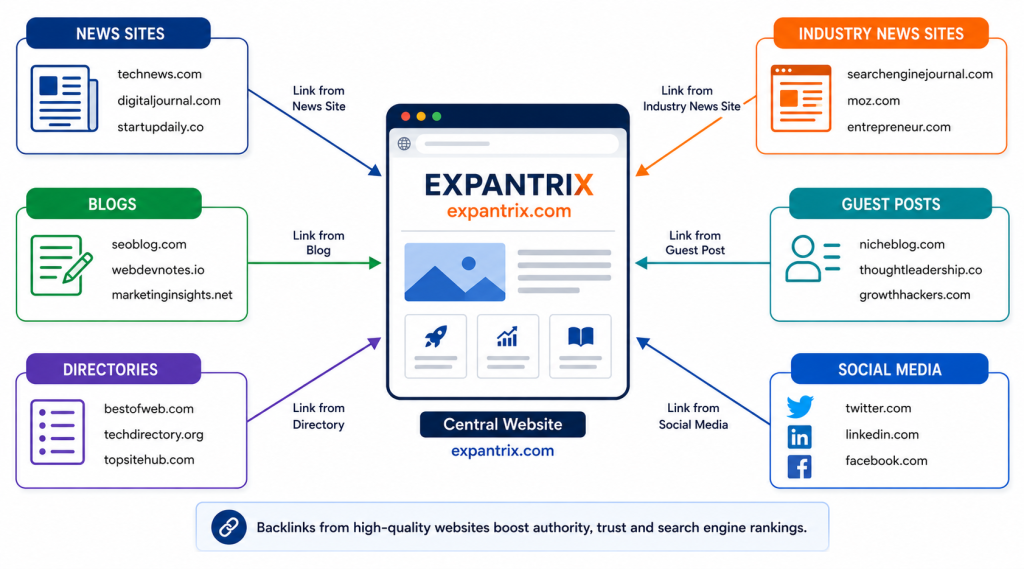
Off-page SEO refers to actions taken outside of your own website to improve its authority and rankings. The most important off-page SEO factor is backlinks.
1. Backlinks — The Currency of SEO
A backlink is a link from another website to your website. Google treats backlinks as ‘votes of confidence’ — the more high-quality, relevant websites link to you, the more authoritative Google considers your site to be.
Not all backlinks are equal:
- High-authority backlinks (from BBC, Forbes, Wikipedia, .gov sites) = very powerful
- Relevant niche backlinks (from related industry websites) = very valuable
- Low-quality or spam backlinks (from link farms, PBNs) = potentially harmful
2. How to Build Quality Backlinks in 2026
- Create Link-Worthy Content: Publish original research, infographics, comprehensive guides, or unique data that other websites naturally want to reference.
- Guest Blogging: Write articles for reputable websites in your industry. In return, you get a backlink to your site.
- Broken Link Building: Find broken links on other websites and suggest your content as a replacement.
- Digital PR: Get mentioned in online publications, news articles, and industry reports.
- Resource Page Link Building: Get listed on ‘useful resources’ pages in your niche.
- HARO (Help a Reporter Out): Respond to journalist queries and get cited in articles.
3. Other Off-Page SEO Signals
- Brand Mentions: When other sites mention your brand name (even without a link), this builds brand authority.
- Social Signals: While not a direct ranking factor, social shares increase content visibility and can lead to more backlinks.
- Online Reviews: For local businesses, Google reviews on your Google Business Profile are a significant local SEO ranking factor.
- Podcast Appearances & Interviews: Build brand authority and often earn backlinks.
Technical SEO — Complete Guide
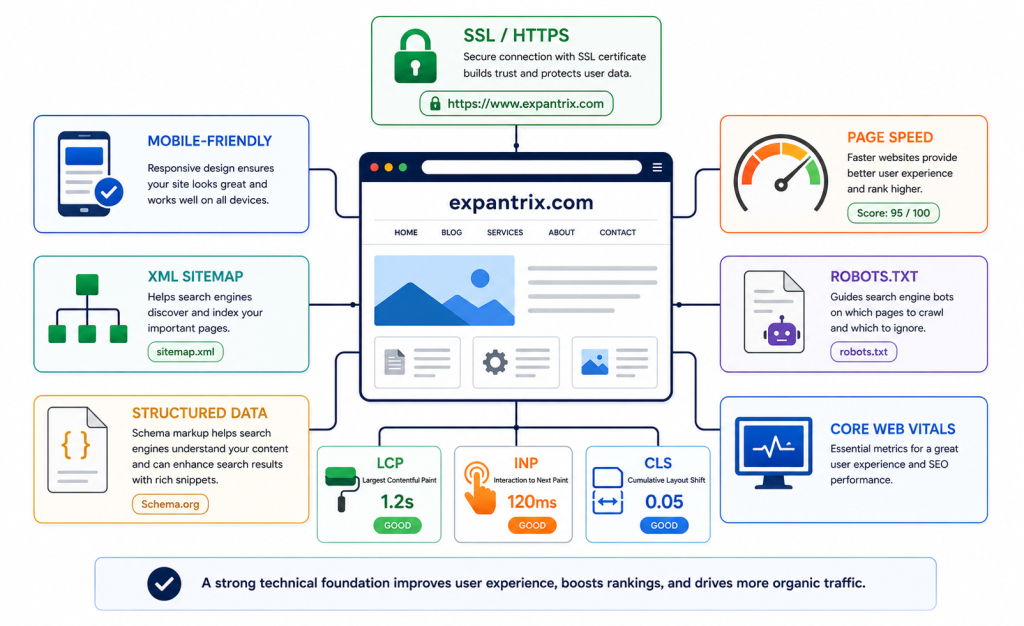
Technical SEO ensures that your website meets the technical requirements of modern search engines. Even the best content will not rank if search engines cannot properly crawl, index, or understand your website.
Essential Technical SEO Factors in 2026
| Technical Factor | Why It Matters | How to Check / Fix |
|---|---|---|
| HTTPS / SSL | Security signal; Google ranking factor | Install an SSL certificate; ensure all pages use https:// |
| Mobile-Friendliness | Google uses mobile-first indexing | Google Mobile-Friendly Test tool |
| Core Web Vitals | Direct ranking factor since 2021 | Google PageSpeed Insights / Search Console |
| Page Speed | User experience + ranking factor | Compress images, use CDN, optimise code |
| XML Sitemap | Helps Google discover all your pages | Generate with RankMath; submit in Search Console |
| Robots.txt | Controls which pages crawlers can access | Check /robots.txt; ensure important pages not blocked |
| Canonical Tags | Prevents duplicate content issues | Use rel=’canonical’ on duplicate/similar pages |
| Structured Data | Enables rich results in SERPs | Add FAQ, Article, Breadcrumb schema via RankMath |
| Site Architecture | Logical URL structure + internal links | No page more than 3 clicks from homepage |
| 404 Error Pages | Broken pages harm UX and crawl budget | Monitor in Search Console; redirect or fix |
| Page Indexing | Ensures all important pages are indexed | Check ‘Coverage’ report in Google Search Console |
✅ SEO TIP: Google Search Console (free) is your most important technical SEO tool. It shows which pages are indexed, which have errors, your Core Web Vitals scores, and which queries bring visitors to your site. Connect it via Google Site Kit plugin in WordPress.
Keyword Research — The Foundation of SEO
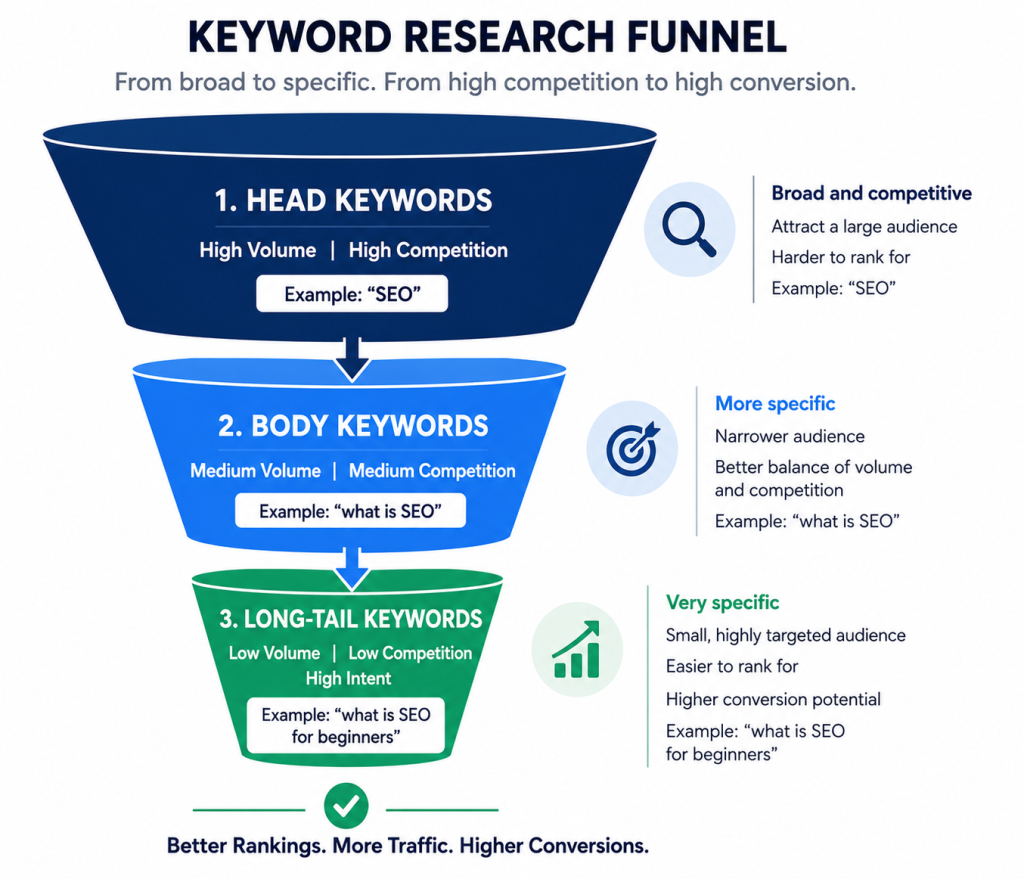
Keyword research is the process of discovering the words and phrases your target audience types into search engines. It is the foundation of all SEO — without the right keywords, even the best content will not reach the right people.
Types of Keywords
| Type | Example | Search Volume | Competition |
|---|---|---|---|
| Head / Short-tail | ‘SEO’ | 1M+/mo | Extremely High |
| Body / Mid-tail | ‘what is SEO’ | 40K+/mo | High |
| Long-tail | ‘what is SEO for small businesses’ | 1K–5K/mo | Low–Medium |
| Question keywords | ‘how does SEO work step by step’ | 2K–10K/mo | Medium |
| Local keywords | ‘SEO agency in Dhaka’ | Varies | Low–Medium |
| LSI / Semantic | ‘search engine optimisation tips’ | Varies | Medium |
How to Do Keyword Research
- Start with a Seed Keyword: Begin with your main topic (e.g., ‘SEO’) and expand from there.
- Use Keyword Research Tools: Enter your seed keyword into tools to find related terms, volumes, and difficulty scores.
- Analyse Search Intent: Determine what the user actually wants — information, a product, a comparison?
- Check Competition: Look at what pages currently rank for your target keyword.
- Select Your Target Keywords: Choose a focus keyword + 3–5 secondary keywords per article.
Best Free & Paid Keyword Research Tools
- Google Keyword Planner (Free) — official Google tool with volume estimates
- Google Search Console (Free) — see what keywords you already rank for
- Ubersuggest (Free/Paid) — beginner-friendly keyword research
- Ahrefs Keywords Explorer (Paid) — most comprehensive data
- SEMrush (Paid) — excellent competitor keyword analysis
- AnswerThePublic (Free limited) — question-based keyword discovery
- Google Autocomplete — type your keyword in Google and see suggestions
Content and SEO — How They Work Together
‘Content is king’ — this phrase has been used in SEO for decades, and in 2026, it is more true than ever. Google’s primary goal is to provide the best possible answer to every search query. High-quality, relevant content is how you align with that goal.
What Makes Content SEO-Friendly?
- Search Intent Match: Your content answers exactly what the user is looking for
- Comprehensiveness: Covers the topic more thoroughly than competing pages
- Readability: Well-structured, easy to scan with headers, bullets, and short paragraphs
- Originality: Unique insights, data, or perspectives — not just reworded competitors’ content
- Freshness: Updated regularly to keep information accurate and current
- Multimedia: Images, videos, infographics, and charts increase engagement
- Correct Keyword Usage: Natural inclusion of focus and secondary keywords
Content Types That Rank Well in 2026
| Content Type | Best For | SEO Strength |
|---|---|---|
| Pillar / Ultimate Guides | Comprehensive topics | Very High — attracts backlinks + long dwell time |
| How-To Articles | Step-by-step tutorials | High — targets ‘how’ queries + featured snippets |
| List Articles (Listicles) | Tools, tips, resources | High — easy to read + featured snippet eligible |
| Comparison Articles | Product/service decisions | Very High — high purchase intent |
| FAQ Articles | Common questions in a niche | High — targets ‘People Also Ask’ section |
| Case Studies | Demonstrating results | Medium-High — excellent for E-E-A-T |
| Infographics | Visual data representation | High — earns backlinks naturally |
| Video Content | Complex demonstrations | High — Google shows video results prominently |
E-E-A-T: Google’s Quality Standard
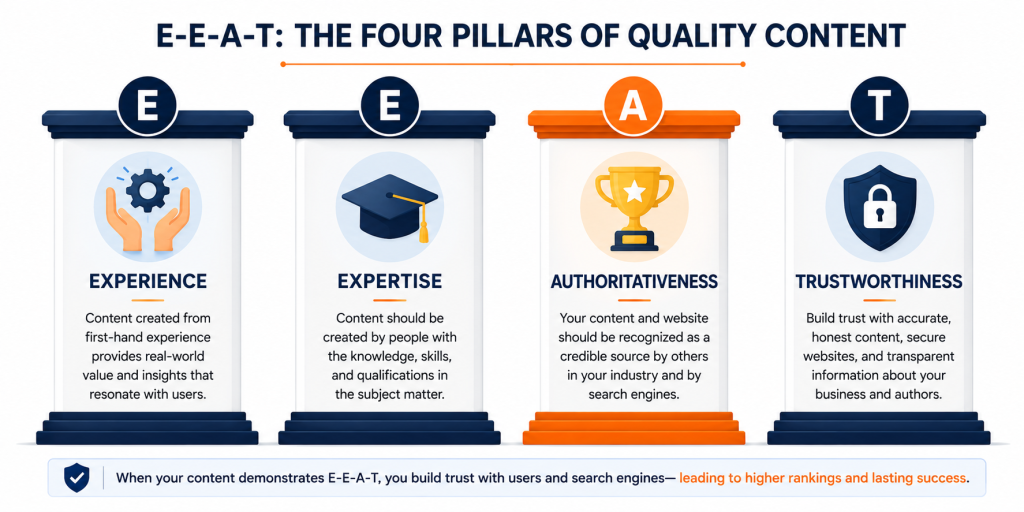
E-E-A-T stands for Experience, Expertise, Authoritativeness, and Trustworthiness. Introduced by Google in its Search Quality Rater Guidelines, E-E-A-T is a framework Google uses to evaluate the quality and credibility of content.
| Element | What It Means | How to Demonstrate It |
|---|---|---|
| Experience | First-hand experience with the topic | Include personal stories, case studies, original screenshots, real examples |
| Expertise | Deep knowledge of the subject matter | Author bio with credentials, in-depth content, accurate information |
| Authoritativeness | Recognition as an authority in your field | Backlinks from reputable sites, brand mentions, citations by others |
| Trustworthiness | The site is honest, accurate, and transparent | HTTPS, clear privacy policy, citations, factual accuracy, about page |
⚠️ IMPORTANT: YMYL (Your Money, Your Life) topics — finance, health, law, safety — are held to the highest E-E-A-T standards by Google. These topics require the most rigorous demonstration of expertise and authority to rank well.
SEO Ranking Factors in 2026
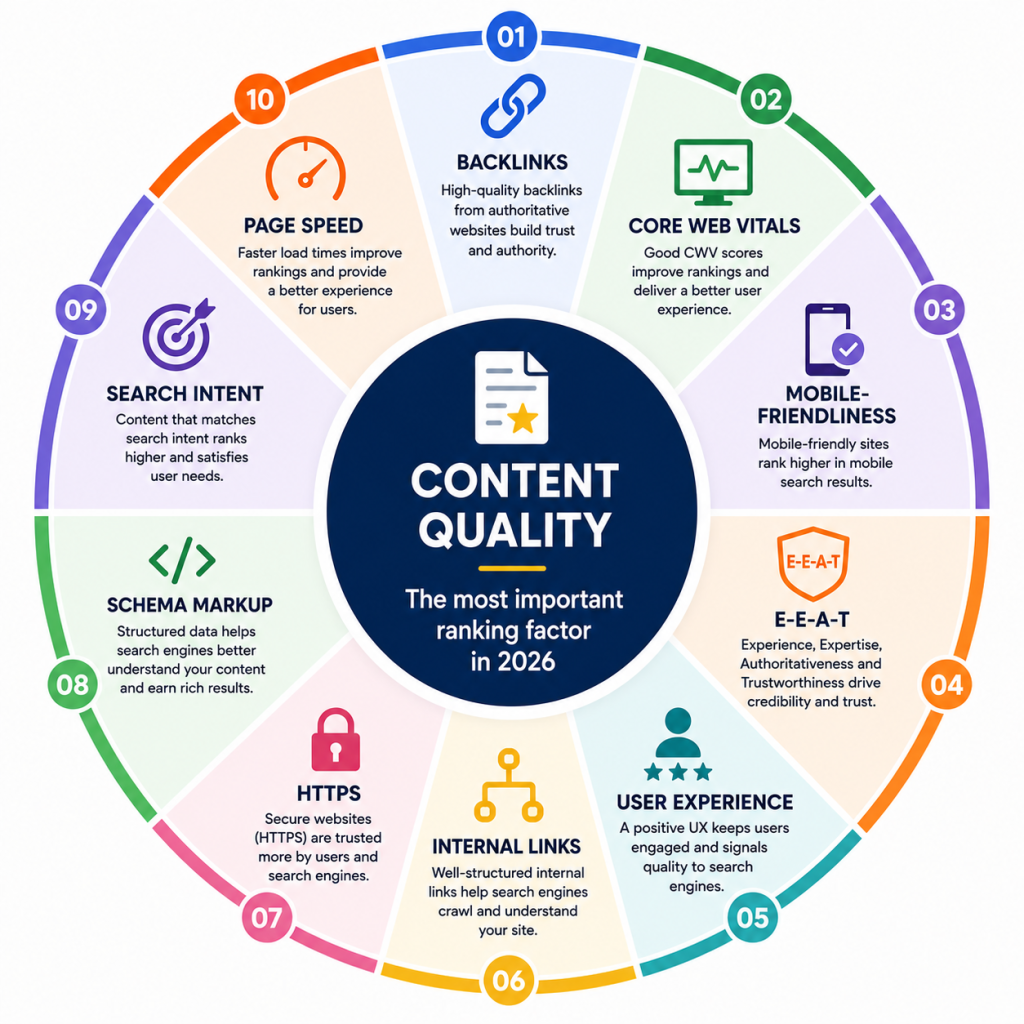
Google uses over 200 ranking factors to determine where a page ranks. While Google does not publicly list all of them, SEO experts and data analysis have identified the most important ones:
| Ranking Factor | Importance Level | What It Means |
|---|---|---|
| Content Quality & Relevance | 🔴 Critical | Content must match search intent and be more helpful than competitors |
| Backlinks (Quality & Quantity) | 🔴 Critical | High-authority sites linking to you = strong trust signal |
| Core Web Vitals | 🔴 Critical | LCP, INP, CLS — Google’s page experience metrics |
| Mobile-Friendliness | 🔴 Critical | Google uses mobile-first indexing — mobile UX is paramount |
| HTTPS Security | 🔴 Critical | All sites should use SSL — confirmed ranking signal |
| E-E-A-T Signals | 🟠 Very High | Content expertise, author credibility, site authority |
| Page Speed | 🟠 Very High | Fast sites rank higher and have lower bounce rates |
| Keyword Optimisation | 🟠 Very High | Strategic use of target keywords in key on-page elements |
| User Experience (UX) | 🟠 Very High | Time on page, bounce rate, pages per session |
| Internal Linking | 🟡 High | Helps Google understand site structure and page relationships |
| Schema Markup | 🟡 High | Structured data enables rich results (FAQ, How-To, etc.) |
| Domain Authority | 🟡 High | Overall strength of your website’s backlink profile |
| Content Freshness | 🟡 Medium-High | Updated content signals relevance for time-sensitive topics |
| Social Signals | 🟢 Medium | Indirect impact — increases content visibility and sharing |
Best SEO Tools in 2026
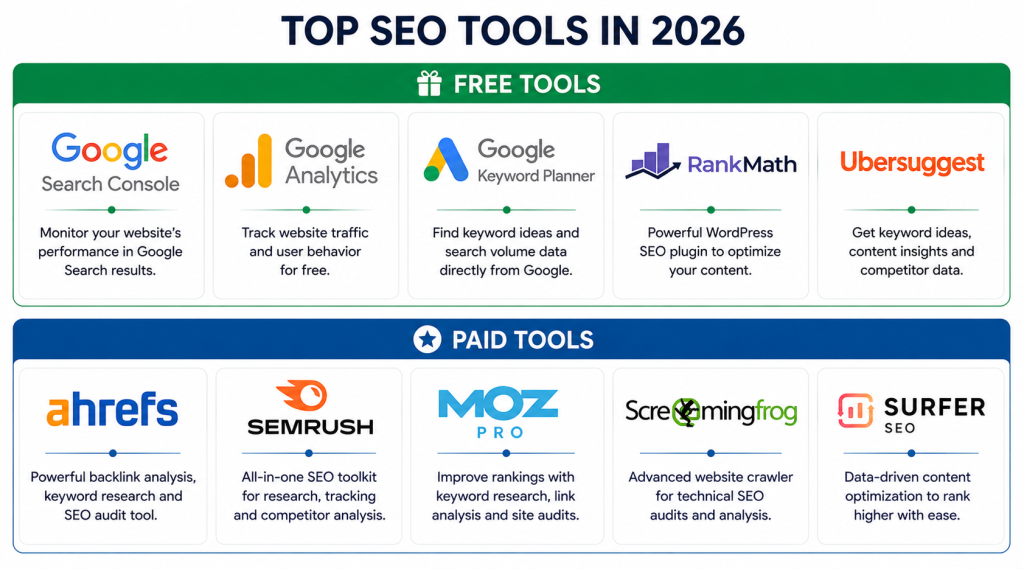
| Tool | Category | Price | Best For |
|---|---|---|---|
| Google Search Console | Technical / Analytics | Free | Monitoring indexing, search performance, Core Web Vitals |
| Google Analytics 4 | Analytics | Free | Understanding user behaviour, traffic sources, conversions |
| RankMath | WordPress SEO Plugin | Free / Premium | On-page SEO, schema markup, sitemap, redirects |
| Google Site Kit | WordPress Plugin | Free | Connecting Search Console + Analytics in WordPress dashboard |
| Google Keyword Planner | Keyword Research | Free | Finding keyword volume and competition data |
| Ubersuggest | All-in-one | Free / $29+/mo | Keyword research, competitor analysis, site audit |
| Ahrefs | All-in-one | $99–$999+/mo | Backlink analysis, keyword research, content gap analysis |
| SEMrush | All-in-one | $139–$499+/mo | Competitor research, position tracking, site audit |
| Screaming Frog | Technical SEO | Free / £149/yr | Technical site crawl — finds all on-page SEO issues |
| Surfer SEO | Content Optimisation | $89–$219+/mo | Optimising content against top-ranking competitors |
| AnswerThePublic | Keyword Research | Free limited | Discovering question-based keywords |
| PageSpeed Insights | Technical | Free | Google’s tool for speed and Core Web Vitals testing |
Local SEO — Getting Found in Your Area
If you run a local business — a restaurant, a shop, a service provider — Local SEO is essential. It helps your business appear in local search results and Google Maps when people search for businesses near them.
Key Local SEO Strategies
- Google Business Profile (GBP): Claim and fully optimise your free Google Business Profile listing — this is the single most impactful local SEO action you can take.
- Local Keywords: Include your city/area in your content, title tags, and meta descriptions (e.g., ‘web developer in Dhaka’).
- NAP Consistency: Ensure your Business Name, Address, and Phone number are identical across all online directories.
- Local Citations: Get listed on relevant local directories (Yellow Pages, local business associations).
- Google Reviews: Encourage satisfied customers to leave Google reviews — quantity and quality both matter.
- Local Content: Create content that targets local events, news, and community topics.
SEO vs. Paid Ads (SEM) — Key Differences
| Factor | SEO (Organic Search) | SEM / PPC (Paid Ads) |
|---|---|---|
| Cost | Free traffic (time investment required) | Pay per click |
| Speed | Slow — results in weeks to months | Instant — ads run immediately |
| Longevity | Traffic continues after work is done | Stops when budget runs out |
| Trust | Higher — users trust organic results | Lower — ‘Ad’ label reduces trust |
| Click Share | ~70–80% of total search clicks | ~20–30% of total search clicks |
| Scalability | Scales with content + links (time) | Scales with budget (money) |
| Best For | Long-term brand building, content sites | Product launches, promotions, testing |
Best Strategy in 2026: Use BOTH together. PPC provides immediate traffic and tests which keywords convert. SEO builds sustainable long-term authority. The combination delivers the best overall return.
How Long Does SEO Take?
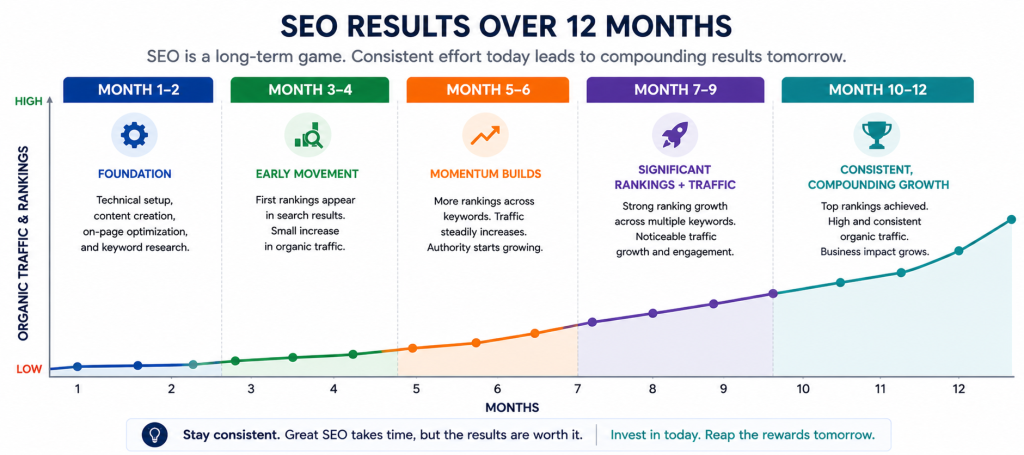
This is one of the most common questions about SEO. The honest answer: SEO is a long-term strategy. Most websites begin to see meaningful results within 3–6 months of consistent effort, with significant results appearing at the 6–12 month mark.
| Timeframe | What to Expect | Key Actions |
|---|---|---|
| Month 1–2 | Foundation building — little to no visible ranking changes | Technical SEO, keyword research, content creation, site structure |
| Month 3–4 | First rankings appear for long-tail keywords; small traffic | Continue publishing, start link building, optimise existing content |
| Month 5–6 | Momentum builds — more keywords ranking, traffic growing | Build more backlinks, update older content, expand keyword targeting |
| Month 7–9 | Significant organic traffic; competitive keywords moving up | Scale content production, pursue high-authority backlinks |
| Month 10–12 | Compounding growth — earlier content gains authority | Analyse what works, double down on winning content types |
| Year 2+ | Strong authority; ranking for hundreds/thousands of keywords | Maintain + expand — SEO compounds over time like an investment |
⚠️ IMPORTANT: Beware of any SEO agency or tool that promises page-one rankings in ‘days’ or ‘weeks.’ Legitimate SEO is a long-term process. Shortcuts (black-hat SEO) can result in Google penalties that destroy your rankings.
Frequently Asked Questions (FAQ)
Q1: What does SEO stand for?
SEO stands for Search Engine Optimisation. It is the practice of improving a website’s visibility in search engine results pages (SERPs) to drive more organic (unpaid) traffic.
Q2: Is SEO free?
The traffic you earn from SEO is free — you do not pay Google for organic rankings. However, SEO requires an investment of time, and often money for tools (like Ahrefs or SEMrush) and quality content creation. For a beginner, you can start SEO with completely free tools: Google Search Console, Google Analytics, RankMath (free version), and Google Keyword Planner.
Q3: What is the difference between SEO and SEM?
SEO (Search Engine Optimisation) refers to earning organic (unpaid) rankings through content, backlinks, and technical optimisation. SEM (Search Engine Marketing) typically refers to paid search advertising — paying Google Ads to appear at the top of results. Both appear in search results, but SEO results are free while SEM results are paid.
Q4: What is the most important SEO factor?
There is no single most important factor — SEO requires a combination of content quality, backlinks, technical health, and user experience. However, if forced to name three: (1) High-quality content that matches search intent, (2) Authoritative backlinks from relevant websites, (3) Technical accessibility (fast loading, mobile-friendly, indexed).
Q5: What is black-hat SEO?
Black-hat SEO refers to techniques that violate Google’s Webmaster Guidelines. Examples include keyword stuffing, buying low-quality backlinks, cloaking, hidden text, and content spinning. While these tactics may produce short-term gains, they risk permanent penalties from Google, resulting in dramatic ranking drops or complete removal from search results.
Q6: What is a backlink and why does it matter?
A backlink is a hyperlink from one website that points to another website. Google treats backlinks as endorsements — when a reputable website links to yours, it signals to Google that your content is trustworthy and authoritative. Backlinks are one of the top three ranking factors in Google’s algorithm.
Q7: What is RankMath and why should I use it?
RankMath is a powerful WordPress SEO plugin that helps you optimise every aspect of your website’s on-page SEO. It provides real-time content analysis, schema markup generation, XML sitemap creation, 404 monitoring, redirect management, and integration with Google Search Console and Analytics. It is widely considered the best WordPress SEO plugin in 2026, with a comprehensive free version.
Q8: Does social media affect SEO?
Social media is not a direct Google ranking factor. However, social media indirectly benefits SEO in significant ways: it amplifies content reach (leading to more people seeing and linking to your content), builds brand awareness and search demand, and can drive referral traffic. Publishing content on social platforms and building an audience there is a valuable complementary strategy to SEO.
Conclusion
SEO is not a magic trick, a one-time task, or a quick fix. It is a long-term investment in your website’s visibility, credibility, and authority — an investment that compounds over time and pays dividends for months and years.
Understanding what SEO is forms the foundation. But the real power comes from implementing it consistently: researching the right keywords, creating comprehensive and helpful content, building authoritative backlinks, ensuring your technical foundation is solid, and monitoring your results to continuously improve.
In 2026, with AI-powered search results, voice search, and increasingly sophisticated algorithms, SEO is more important — and more exciting — than ever. The websites that commit to genuine, user-first optimisation will be the ones that earn lasting, sustainable traffic.
At Expantrix.com, we are committed to breaking down complex digital topics — SEO, web development, internet technology, and more — into clear, actionable guides that help you grow your online presence with confidence.
Ready to start your SEO journey? Explore more guides on Expantrix.com!